Or at least a week. :-)
"Ode to the Lemon"
From blossoms
released
by the moonlight,
from an
aroma of exasperated
love,
steeped in fragrance,
yellowness
drifted from the lemon tree,
and from its planetarium
lemons descended to the earth.
Tender yield!
The coasts,
the markets glowed
with light, with
unrefined gold;
we opened
two halves
of a miracle,
congealed acid
trickled
from the hemispheres
of a star,
the most intense liqueur
of nature,
unique, vivid,
concentrated,
born of the cool, fresh
lemon,
of its fragrant house,
its acid, secret symmetry.
Knives
sliced a small
cathedral
in the lemon,
the concealed apse, opened,
revealed acid stained glass,
drops
oozed topaz,
altars,
cool architecture.
So, when you hold
the hemisphere
of a cut lemon
above your plate,
you spill
a universe of gold,
a
yellow goblet
of miracles,
a fragrant nipple
of the earth's breast,
a ray of light that was made fruit,
the minute fire of a planet.
-- Pablo Neruda
(Courtesy of the Wondering Minstrels again: http://www.cs.rice.edu/~ssiyer/minstrels/poems/1702.html)
Monday, January 30, 2006

Friday, January 27, 2006
Down the Rabbit Hole
Kidnapped Stephanie (dear Stephanie) and dragged her along to a film about Russian vampires. Squelch and squish. Also, an ingenious method of storing one's backup weapon.
Some composer's birthday today. Stephanie got her revenge by making me listen to a glass harmonica.
Some writer's birthday, too. Rabbits are for dissecting. I don't care if they're white.
See you on the other side of the mirror, darlings.
Hyacinth.
Some composer's birthday today. Stephanie got her revenge by making me listen to a glass harmonica.
Some writer's birthday, too. Rabbits are for dissecting. I don't care if they're white.
See you on the other side of the mirror, darlings.
Hyacinth.
Thursday, January 26, 2006
Hmmm...
I've been asked to run one of the PASS sessions next trimester for ENGL111. It's like a supplementary tutorial, but run by students that took the course the year before. We're supposed to be less scary or something.
Pros:
1. I'd get to warp naive young minds.
2. It would be teaching experience of a sort.
3. There's Chaucer's "Miller's Tale" which is one of his funnier (and smuttier) offerings. "The Rape of the Lock" was quite fun as well.
Cons:
1. There's Malory's version of King Arthur, which I hated with a white hot passion.
2. The money isn't fantastically great. But then it's only an hour a week, so it's more of a token anyway.
I must think on this.
Pros:
1. I'd get to warp naive young minds.
2. It would be teaching experience of a sort.
3. There's Chaucer's "Miller's Tale" which is one of his funnier (and smuttier) offerings. "The Rape of the Lock" was quite fun as well.
Cons:
1. There's Malory's version of King Arthur, which I hated with a white hot passion.
2. The money isn't fantastically great. But then it's only an hour a week, so it's more of a token anyway.
I must think on this.
Tuesday, January 24, 2006
Well, At Least It Wasn't Windy...
The frisbee game tonight was somewhat damp. Actually, it was very damp, and to add to the insult of being a drowned rat, I was the only girl there for the first half, which meant that I couldn't sub off. Phew.
All of which is lots of exaggeration for dramatic effect, because it turns out that a little bit of rain makes for a very fun game. We didn't get nearly so overheated and there were some amazingly spectacular dives and slides. Also, because I take my victories where I can find them, I survived a frisbee game where I wasn't allowed to sub off in the first half. (Tanja, thank you, you have officially saved my life. :->)
It was very very good to crawl into warm dry clothes when I got home, though.
All of which is lots of exaggeration for dramatic effect, because it turns out that a little bit of rain makes for a very fun game. We didn't get nearly so overheated and there were some amazingly spectacular dives and slides. Also, because I take my victories where I can find them, I survived a frisbee game where I wasn't allowed to sub off in the first half. (Tanja, thank you, you have officially saved my life. :->)
It was very very good to crawl into warm dry clothes when I got home, though.
Monday, January 23, 2006
I Want To Be A World Famous Writer...
...So that when I post a picture of my cat on the Internet, 121 people will all see fit to comment on how beautiful she is. It would be good for her ego.
(Although I'm rather impressed at how many times people can say the same relatively trivial thing, over and over and over. It seems to be the text equivalent of nodding to show that you're still listening.)
(Although I'm rather impressed at how many times people can say the same relatively trivial thing, over and over and over. It seems to be the text equivalent of nodding to show that you're still listening.)
Sunday, January 22, 2006
Review: KapCon
I've never really been to a roleplaying convention before. I missed the various incarnations of the Flying Crocodile Cup, never got around to Battlecry and in general haven't been doing that much tabletop roleplaying lately. I turned up to one of the games in Confusion last year, but I was only there for an afternoon so decline to count it. On the other hand, it turns out that very many of my friends in Wellington, as well as a flatmate (Norman) and visiting guest (Struan) have been considering KapCon as one of the highlights of their social year, so I thought I'd give it a try.
First off, I had a lot of fun. I met many interesting new people, and got to know some other interesting people that I'd previously only had a nodding aquaintance with. The games were also tres cool, even though I didn't play in every session. (I have a tendency to get peopled out, especially in crowds, and the walls of Wellington High School are quite good at reflecting sound. The term "Tidal Wave of Noise" was very applicable at times.)
Of the games I played in, two were fairly standard short games - enjoyable, but they didn't push me out of my comfort zone. The others were somewhat ... interesting. One was a medical soap opera in which we were filming the pilot of Wellington's answer to Shortland St "Bleeding Hearts", which meant acting out scenes - turning into sides of bacon, hurriedly rearranging furniture as needed, upstaging each other like mad, and doing whatever we could to improve our ratings. The plot to kidnap one of the doctors to Molvania that was foiled by a helicopter accidentally taking out the nurse Tiffany (whose real name was Greta something, and was also a mail order bride to my father the hospital accountant) was very memorable.
The other was also a semi-Larp, but much more serious. It was called "Couples", run by a chap called Tony S?, and if I had to name the genre I'd call it psychological realism. We were playing 6 friends (all paired off, but with history) who had gotten together for a weekend away by the lake in Wanaka. The twist was that we all had issues that were giving us serious grief, and the tensions of the holiday brought them all out. It was, without question, the most intense roleplaying I've ever experienced. The character sheets were detailed psych profiles that were based on real people, and after we'd had time to read through them we talked with the GM privately to work out extra details and quirks, and then spent time with our character's partners developing shared history: everything from favourite colours, the cars that we drove, an ordinary evening's entertainment down to things about our sex lives and how we felt about each other. The issues that we had to work out were all things that could happen in our real lives and some of them happened to cut very close to the bone. (I highly recommend this game, but it ain't for the faint hearted.) From a technical perspective, the roleplaying between people became very natural and unforced - the shared reality everyone was creating between them had nothing to do with what the world is like and everything to do with how we related to each other, so everything just flowed smoothly. It was incredibly intense from an emotional perspective, and I spent 20 minutes after the game was over wondering if I was going to burst into tears before turning into Princess Yun Sing for the main Larp of the evening, who is a very different person indeed. I also found that the next day I was still getting odd moments of emotional backlash that ranged from wondering what my character would be doing in 6 months time, to how I, a very different person, would have reacted to the same events. (It's rather astonishing, when you think about it, how much immersing into a character can protect your real psyche from weird shit.) I'm very glad that I got a private debriefing with Tony the next day, and I'm also very glad that I got to play in the game.
The main Larp "Rule Brittania" was great. I played a Chinese princess with a thirst for travel, some special magic medicine and a dark secret about how the medicine was made. I achieved all of my goals as well as an extra that turned up during the game. (Andy, if you ever read this, waving The Book at you after the game was over and seeing you mouthing swear words at me truly made my night.) There was too much stuff going on to describe with any justice, but I take my hairpins off to the wonderfully sinister Fu Manchu, a seedy-looking businessman, who happened to be a really nice guy. (Alas, my character kept on wondering what the hell she was going to have to pay him back with later, but she really appreciated all the help he gave her.) I do have one regret though - I was playing a character who looked vulnerable and innocent but was actually dripping with Kick Arse fighting ability and magic charms that protected her from dark magic. Did anyone attack me, at all? Nope.
Logistically speaking, the con was organised with ruthless and impressive efficiency, capable of handling even my feckless and tardy self with grace and aplomb. There were no problems. At all. Everything was announced clearly, it was easy to find the game rooms (although Struan and I got lost finding the main entrance on our first day), there were snacks available at a reasonable price, there were food runs for cheap pizza and, I kid you not, everything started and finished bang on time. I didn't think it could be done, but now I have learnt my error and will henceforth strive harder to please the Gods of Punctuality in my own paltry organising efforts.
How did it compare to Science Fiction conventions, with which I have considerably more experience? Well, it's not in a hotel, so room parties, hanging out in the bar, and lounging around the piano singing filks badly just didn't happen. It was a lot less casual, unlike SF Cons where you can wander in and out of panels as you please, here you needed to sign up for 3 hour games in advance and if you were late, they might be able to slot you in, or then again they might now. There was still the atmosphere of hanging out in the foyer chatting and playing games, though, which is one of the better parts of cons everywhere.
KapCon. Do I recommend it? Absolutely.
First off, I had a lot of fun. I met many interesting new people, and got to know some other interesting people that I'd previously only had a nodding aquaintance with. The games were also tres cool, even though I didn't play in every session. (I have a tendency to get peopled out, especially in crowds, and the walls of Wellington High School are quite good at reflecting sound. The term "Tidal Wave of Noise" was very applicable at times.)
Of the games I played in, two were fairly standard short games - enjoyable, but they didn't push me out of my comfort zone. The others were somewhat ... interesting. One was a medical soap opera in which we were filming the pilot of Wellington's answer to Shortland St "Bleeding Hearts", which meant acting out scenes - turning into sides of bacon, hurriedly rearranging furniture as needed, upstaging each other like mad, and doing whatever we could to improve our ratings. The plot to kidnap one of the doctors to Molvania that was foiled by a helicopter accidentally taking out the nurse Tiffany (whose real name was Greta something, and was also a mail order bride to my father the hospital accountant) was very memorable.
The other was also a semi-Larp, but much more serious. It was called "Couples", run by a chap called Tony S?, and if I had to name the genre I'd call it psychological realism. We were playing 6 friends (all paired off, but with history) who had gotten together for a weekend away by the lake in Wanaka. The twist was that we all had issues that were giving us serious grief, and the tensions of the holiday brought them all out. It was, without question, the most intense roleplaying I've ever experienced. The character sheets were detailed psych profiles that were based on real people, and after we'd had time to read through them we talked with the GM privately to work out extra details and quirks, and then spent time with our character's partners developing shared history: everything from favourite colours, the cars that we drove, an ordinary evening's entertainment down to things about our sex lives and how we felt about each other. The issues that we had to work out were all things that could happen in our real lives and some of them happened to cut very close to the bone. (I highly recommend this game, but it ain't for the faint hearted.) From a technical perspective, the roleplaying between people became very natural and unforced - the shared reality everyone was creating between them had nothing to do with what the world is like and everything to do with how we related to each other, so everything just flowed smoothly. It was incredibly intense from an emotional perspective, and I spent 20 minutes after the game was over wondering if I was going to burst into tears before turning into Princess Yun Sing for the main Larp of the evening, who is a very different person indeed. I also found that the next day I was still getting odd moments of emotional backlash that ranged from wondering what my character would be doing in 6 months time, to how I, a very different person, would have reacted to the same events. (It's rather astonishing, when you think about it, how much immersing into a character can protect your real psyche from weird shit.) I'm very glad that I got a private debriefing with Tony the next day, and I'm also very glad that I got to play in the game.
The main Larp "Rule Brittania" was great. I played a Chinese princess with a thirst for travel, some special magic medicine and a dark secret about how the medicine was made. I achieved all of my goals as well as an extra that turned up during the game. (Andy, if you ever read this, waving The Book at you after the game was over and seeing you mouthing swear words at me truly made my night.) There was too much stuff going on to describe with any justice, but I take my hairpins off to the wonderfully sinister Fu Manchu, a seedy-looking businessman, who happened to be a really nice guy. (Alas, my character kept on wondering what the hell she was going to have to pay him back with later, but she really appreciated all the help he gave her.) I do have one regret though - I was playing a character who looked vulnerable and innocent but was actually dripping with Kick Arse fighting ability and magic charms that protected her from dark magic. Did anyone attack me, at all? Nope.
Logistically speaking, the con was organised with ruthless and impressive efficiency, capable of handling even my feckless and tardy self with grace and aplomb. There were no problems. At all. Everything was announced clearly, it was easy to find the game rooms (although Struan and I got lost finding the main entrance on our first day), there were snacks available at a reasonable price, there were food runs for cheap pizza and, I kid you not, everything started and finished bang on time. I didn't think it could be done, but now I have learnt my error and will henceforth strive harder to please the Gods of Punctuality in my own paltry organising efforts.
How did it compare to Science Fiction conventions, with which I have considerably more experience? Well, it's not in a hotel, so room parties, hanging out in the bar, and lounging around the piano singing filks badly just didn't happen. It was a lot less casual, unlike SF Cons where you can wander in and out of panels as you please, here you needed to sign up for 3 hour games in advance and if you were late, they might be able to slot you in, or then again they might now. There was still the atmosphere of hanging out in the foyer chatting and playing games, though, which is one of the better parts of cons everywhere.
KapCon. Do I recommend it? Absolutely.
Wednesday, January 18, 2006
Gaudy Night
I've lately been rereading Gaudy Night by Dorothy L. Sayers, which is a lovely book for many reasons, including interesting characters, beautiful prose, a detailed description of Oxford life in 1935, and being a detective story that can be taking seriously by literature professors who happen to like detective stories. It also has little gems like these:
"Hard-boiled or soft-boiled?"
"Hard, I think."
This question had no reference to Dr. Threep's politics or economics, but only to his shirt-front. Harriet and the Dean had begun to collect shirt-fronts. Miss Chilperic's "young man" had started the collection. He was extremely tall and thin and rather hollow-chested; by way of emphasising this latter defect, he always wore a soft pleated dress-shirt, which made him look (according to the Dean) like the scooped-out rind of a melon. By way of contrast, there had been an eminent and ample professor of chemisty - a visitor from another university - who had turned up in a front of intense rigidity, which stood out before him like the chest of a pouter pidgeon, bulging out of all control and displaying a large area of the parent shirt at either side. A third variety of shirt fairly common among the learned was that which escaped from the centre stud and gaped in the middle; and one never-to-be-forgotten happy day a popular poet had arrived to give a lecture on his methods of composition and the future of poetry, whereby, at every gesticulation (and he had used a great many) his waistcoat had leapt in the air, allowing a line of shirt, adorned with a little tab, to peep out, rabbit-like, over the waistline of the confining trouser. On this occasion, Harriet and the Dean had disgraced themselves badly.
Sayers, Dorothy L, Gaudy Night, (London: Hodder and Stoughton), 1970, p256.
"Hard-boiled or soft-boiled?"
"Hard, I think."
This question had no reference to Dr. Threep's politics or economics, but only to his shirt-front. Harriet and the Dean had begun to collect shirt-fronts. Miss Chilperic's "young man" had started the collection. He was extremely tall and thin and rather hollow-chested; by way of emphasising this latter defect, he always wore a soft pleated dress-shirt, which made him look (according to the Dean) like the scooped-out rind of a melon. By way of contrast, there had been an eminent and ample professor of chemisty - a visitor from another university - who had turned up in a front of intense rigidity, which stood out before him like the chest of a pouter pidgeon, bulging out of all control and displaying a large area of the parent shirt at either side. A third variety of shirt fairly common among the learned was that which escaped from the centre stud and gaped in the middle; and one never-to-be-forgotten happy day a popular poet had arrived to give a lecture on his methods of composition and the future of poetry, whereby, at every gesticulation (and he had used a great many) his waistcoat had leapt in the air, allowing a line of shirt, adorned with a little tab, to peep out, rabbit-like, over the waistline of the confining trouser. On this occasion, Harriet and the Dean had disgraced themselves badly.
Sayers, Dorothy L, Gaudy Night, (London: Hodder and Stoughton), 1970, p256.
Monday, January 16, 2006
Commonplace Book
In honour of Neil Gaiman's very entertaining blog, most recently entitled The Return of The Devil's Foot, an oldie but a goodie:
Song
Go and catch a falling star,
Get with child a mandrake root,
Tell me where all past years are,
Or who cleft the devils foot;
Teach me to hear mermaids singing,
Or to keep off envy's stinging,
And find
What wind
Serves to advance an honest mind.
If thou be'st born to strange sights,
Things invisible to see,
Ride ten thousand days and nights
Till Age snow white hairs on thee;
Thou, when thou return'st wilt tell me
All strange wonders that befell thee,
And swear
No where
Lives a woman true and fair.
If thou find'st one let me know;
Such a pilgrimage were sweet.
Yet do not; I would not go,
Though at next door we might meet.
Though she were true when you met her,
And last, till you write your letter,
Yet she
Will be
False, ere I come, to two or three.
-- John Donne
Used to good effect in Howl's Moving Castle by Dianna Wynne Jones, although it was, alas, left out of the recent movie.
(Courtesy of Wondering Minstrels: http://www.cs.rice.edu/~ssiyer/minstrels/poems/384.html)
Song
Go and catch a falling star,
Get with child a mandrake root,
Tell me where all past years are,
Or who cleft the devils foot;
Teach me to hear mermaids singing,
Or to keep off envy's stinging,
And find
What wind
Serves to advance an honest mind.
If thou be'st born to strange sights,
Things invisible to see,
Ride ten thousand days and nights
Till Age snow white hairs on thee;
Thou, when thou return'st wilt tell me
All strange wonders that befell thee,
And swear
No where
Lives a woman true and fair.
If thou find'st one let me know;
Such a pilgrimage were sweet.
Yet do not; I would not go,
Though at next door we might meet.
Though she were true when you met her,
And last, till you write your letter,
Yet she
Will be
False, ere I come, to two or three.
-- John Donne
Used to good effect in Howl's Moving Castle by Dianna Wynne Jones, although it was, alas, left out of the recent movie.
(Courtesy of Wondering Minstrels: http://www.cs.rice.edu/~ssiyer/minstrels/poems/384.html)
Friday, January 13, 2006
The Moon Is Very Beautiful Tonight.
It's full and round and bright and the Man in the Moon is smiling down at me, and then all of a sudden my eyes change focus and it's Rona and her bucket of water.
The clouds have been scudding across, some light and white and fluffy, others dark enough to hide it completely.
And now it's gone. Maybe it'll rain tomorrow...
The clouds have been scudding across, some light and white and fluffy, others dark enough to hide it completely.
And now it's gone. Maybe it'll rain tomorrow...
Saturday, January 07, 2006
A Potage of Roysons
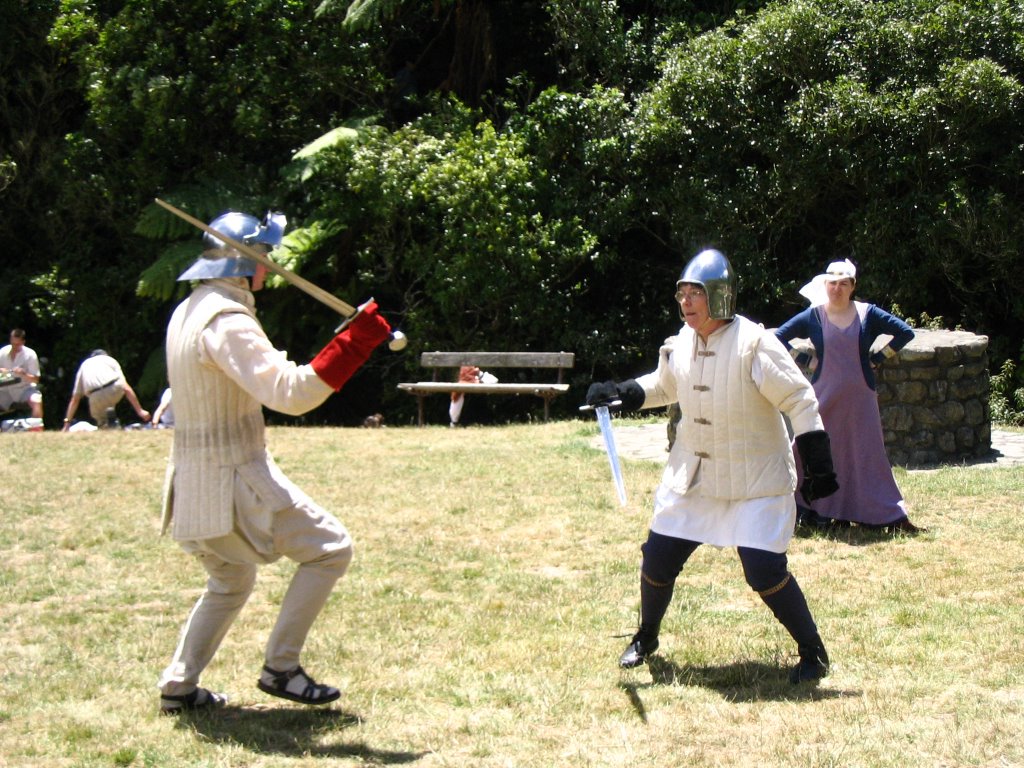
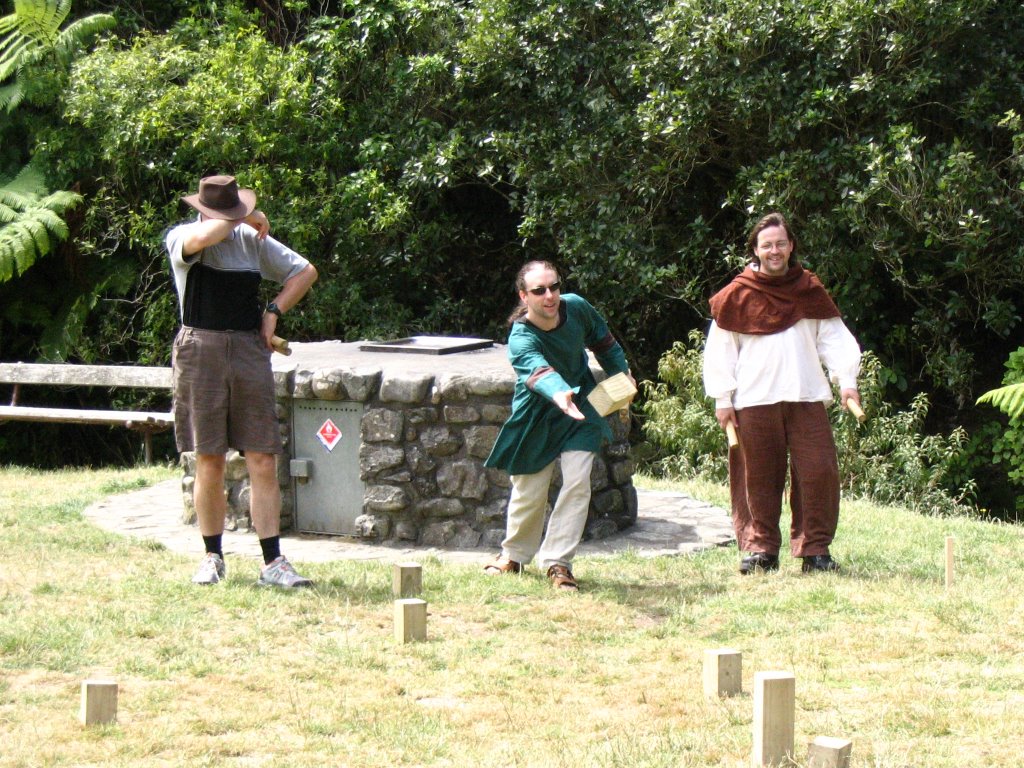
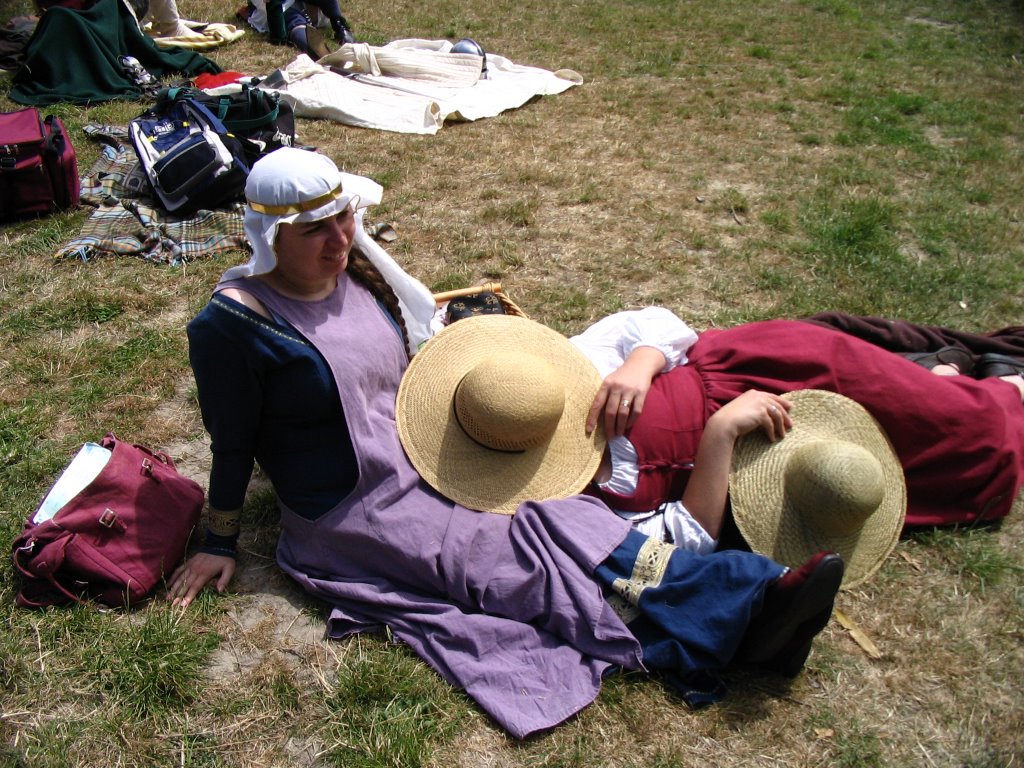
I'm going to a picnic with the Medieval Guild tomorrow. They said to bring a plate of something sort of medieval, so I'm going to be experimental and try a real old-time recipe, courtesy of www.godecookery.com. Here goes:
.Cxxxvj. A potage of Roysons. Take Raysonys, & do a-way þe kyrnellys; & take a part of Applys, do a-way þe corys, & þe pare, bray hem in a mortere, & temper hem with Almande Mylke, melle hem with flowre of Rys, þat it be clene chargeaunt, & straw vppe-on pouder of Galygale of Gyngere, serue it forth.
Stage 1: Almond Milk
Apparently medieval cooks didn't like using cow's milk in their recipes. It went off, or got diluted by the street seller and well, frankly, you didn't know where it had been. The solution was to grind up almonds and steep them in water and use that instead. Currently, I have a pot of just boiled water making the acquaintance of a packet of ground almonds from the supermarket bakery department and they seem to be hitting it off (ie its now white and milky looking with some almond particles in there). In about 5 minutes I have to strain the relationship and see what comes out (GodeCookery recommend the services of a blender but that I just don't have).
...
As promised, smells like almonds, looks like very off-white skim milk. I think if I leave it to sit, it'll separate out.
(The next morning.) Nope, it didn't separate. It's definitely cloudy, but the almond is still mostly in solution.
Stage 2: Stew Your Apple
Pretty basic really, although I had to change to a bigger pot when I realised how much you get out of 5 apples. Which cooks down quite a lot actually. I've never actually stewed apples before. Simmer, bubble, toil and trouble. (It helps if you don't overboil the pot.)
Stage 3: Putting It All Together
The initial pile of stuff all dumped in together looks quite unappealing, all congealed and icky looking, but smells wonderfully of ginger. After some cooking, the milk has absorbed into the apple and the mixture is thicker and looks more appetising. Still smells nice. And on getting it as thick as it's ever going to be, I think I'll transfer it to a serving dish and leave it to settle.

Stage 4: The Eating
I thought it was really nice - stewed apple with some extra zing, although only one other person tried it. :-( Maybe bringing some plastic spoons or something would have increased the uptake... The picnic was fun, too.


.Cxxxvj. A potage of Roysons. Take Raysonys, & do a-way þe kyrnellys; & take a part of Applys, do a-way þe corys, & þe pare, bray hem in a mortere, & temper hem with Almande Mylke, melle hem with flowre of Rys, þat it be clene chargeaunt, & straw vppe-on pouder of Galygale of Gyngere, serue it forth.
Stage 1: Almond Milk
Apparently medieval cooks didn't like using cow's milk in their recipes. It went off, or got diluted by the street seller and well, frankly, you didn't know where it had been. The solution was to grind up almonds and steep them in water and use that instead. Currently, I have a pot of just boiled water making the acquaintance of a packet of ground almonds from the supermarket bakery department and they seem to be hitting it off (ie its now white and milky looking with some almond particles in there). In about 5 minutes I have to strain the relationship and see what comes out (GodeCookery recommend the services of a blender but that I just don't have).
...
As promised, smells like almonds, looks like very off-white skim milk. I think if I leave it to sit, it'll separate out.
(The next morning.) Nope, it didn't separate. It's definitely cloudy, but the almond is still mostly in solution.
Stage 2: Stew Your Apple
Pretty basic really, although I had to change to a bigger pot when I realised how much you get out of 5 apples. Which cooks down quite a lot actually. I've never actually stewed apples before. Simmer, bubble, toil and trouble. (It helps if you don't overboil the pot.)
Stage 3: Putting It All Together
The initial pile of stuff all dumped in together looks quite unappealing, all congealed and icky looking, but smells wonderfully of ginger. After some cooking, the milk has absorbed into the apple and the mixture is thicker and looks more appetising. Still smells nice. And on getting it as thick as it's ever going to be, I think I'll transfer it to a serving dish and leave it to settle.
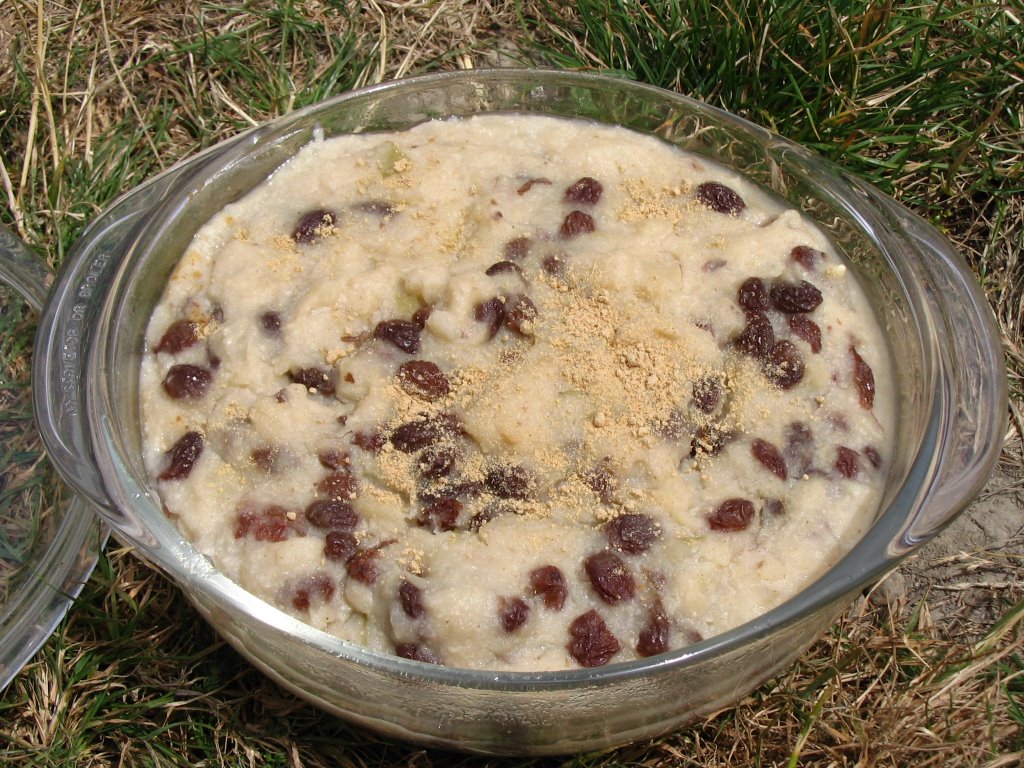
Stage 4: The Eating
I thought it was really nice - stewed apple with some extra zing, although only one other person tried it. :-( Maybe bringing some plastic spoons or something would have increased the uptake... The picnic was fun, too.

Monday, January 02, 2006
Mmmm...
For those with a vested interest, and the occasional bloke with an interest in what men ought not wot of, there was a discussion on LiveJournal a little while ago about what kinds of things about the male gender catch one's eye. Heath Ledger was mentioned as a positive example. Tanja and I have just spent the afternoon watching Heath Ledger movies. Damn, but that boy has a nice voice. And smile. And really nice eyes. And...
(Cat, you were right. 10 Things I Hate About You is a very funny movie. :->)
(Cat, you were right. 10 Things I Hate About You is a very funny movie. :->)
Friday, December 30, 2005
Strange But True...
The science fiction TV program Buck Rogers in the 25th Century, (the 1978 edition), was the originator of Spandex as a fashion statement. The costume designer, Jean-Pierre Dorleac found a fabric previously used in women's underwear for things like the side panels in girdles and turned it inside out to lose the high-gloss effect. He says that "[The producer] had an idea silhouette-wise of what Buck Rogers should look like. He wanted him all in white and he wanted it very sleek and tight fitting."
Jean-Pierre, you have much to answer for.
Simak, Steven A., "25th Century Style", CFQ: Cinefantastique, (New Milford: Curtis Circulation Company), December/January 2005, p47.
Jean-Pierre, you have much to answer for.
Simak, Steven A., "25th Century Style", CFQ: Cinefantastique, (New Milford: Curtis Circulation Company), December/January 2005, p47.
Monday, December 26, 2005
Commonplace Book...
I just read a poem that Dorothy Sayers wrote about being thankful which I rather liked. (This was written early on in WWII when a lot of material goods were becoming scarce.)
I need not shiver in silk stockings; -
I had a hunch about wool before it was rationed;
Now I have knitted myself woollen stockings
That come a long way up.
They are warm and admirable,
They do not ladder or go into holes suddenly.
I can boast quietly about them
And smirk while others admire my industry;
As it happens, I like knitting
And nothing gratifies one more
Than to be admired for doing what one likes.
-- Dorothy L. Sayers
(Hannay, Margaret P. (ed.), As Her Whimsey Took Her: Critical Essays on the Work of Dorothy L. Sayers, Kent: The Kent State University Press, pp211-2)
I need not shiver in silk stockings; -
I had a hunch about wool before it was rationed;
Now I have knitted myself woollen stockings
That come a long way up.
They are warm and admirable,
They do not ladder or go into holes suddenly.
I can boast quietly about them
And smirk while others admire my industry;
As it happens, I like knitting
And nothing gratifies one more
Than to be admired for doing what one likes.
-- Dorothy L. Sayers
(Hannay, Margaret P. (ed.), As Her Whimsey Took Her: Critical Essays on the Work of Dorothy L. Sayers, Kent: The Kent State University Press, pp211-2)
Friday, December 23, 2005
A Guessing Game...
(Borrowed from repton_infinity over on LiveJournal.)
I'm thinking of a book. You can ask Yes/No questions that relate to the content of the book, but not the externals. So it's OK to ask if there is a quest to save the world, but not if it was written before 1980.
It's a science fiction novel. I think it's reasonable that you guys have read it or heard of it. I even own a copy.
First Question:
Do the main characters ever travel from one solar system to another?
-Yes, although to be fair, not during the course of the book.
(Please ask new questions as Blogspot comments and not the RSS feed available on LiveJournal.)
Cheers,
Stephanie
I'm thinking of a book. You can ask Yes/No questions that relate to the content of the book, but not the externals. So it's OK to ask if there is a quest to save the world, but not if it was written before 1980.
It's a science fiction novel. I think it's reasonable that you guys have read it or heard of it. I even own a copy.
First Question:
Do the main characters ever travel from one solar system to another?
-Yes, although to be fair, not during the course of the book.
(Please ask new questions as Blogspot comments and not the RSS feed available on LiveJournal.)
Cheers,
Stephanie
Wednesday, December 21, 2005
I've Been Watching The Man From Uncle
It's very silly. In the last episode, "The Karate Killers", they had to chase around the world finding the flighty step-daughters of a dead scientist so that they could collect bogus scientific formulae inscribed on his photograph, rearrange the letters to "Japanese Lullabye" so that the scientist's real daughter could remember an old friend of her father's who lived in Japan, go to Tokyo, rescue the daughter from a Geisha House, find the old friend, be captured (again) and taken to the North Pole where there was a factory that was extracting gold from sea water. Then they escaped and saved the day.
It had go-go dancers, an impoverished Count, a ski-lift, a dastardly villain and the aforementioned geisha girls.
All in all, quite fun.
It had go-go dancers, an impoverished Count, a ski-lift, a dastardly villain and the aforementioned geisha girls.
All in all, quite fun.
Monday, December 19, 2005
I've Been Being Organised...
Travel booked, Xmas presents dealt with, provision made for my cat, and all in all, I'm feeling much more relaxed about Christmas. Maybe Douglas Adams had it right about random tendrils of Guilt connecting people to things, although, since there is still washing up to be done, I've still got an attachment to my house and everything. So that's a relief.
Steph
Steph
Tuesday, December 13, 2005
In Which I Talk About My Cat...
Because Catherine is sick of me talking about poetry. Actually, it's poetry that I really want to talk about, so this is an attempt to sneak under her radar.
I've been thinking lately that the modern popular conception of poetry is of something that's either difficult and hard to understand for 'posh people' with intellectual pretensions or something that's fun, rhymes and is meant for kids. As a couple of examples, I present for your edification a bona fide 'literary' poem that won awards called "Dismemberment: when in the dark" by Kapka Kassabova and a fun, happy kid's poem called "Recipe for a Hippopotamus Sandwich" by Shel Silverstein, both chosen for the arbitrary reason that I happen to like them.
There are some really obvious differences here. While neither has a fixed verse form, the Silverstein has a very obvious meter and makes heavy use of rhyme. It's designed to rollick through from beginning to end and practically begs to be read out loud. Kassbova's piece has very few rhymes at all, and they're mostly from word repetition. There are some repeated consonantal sounds, but they're mostly internal and subtle, for instance the repeating S sound in "When the moon comes it displays / your passing shadow - a stooped loneliness" which, really, you have to look for to notice. Moreover, the word order seems designed to emphasise the pauses between sentences and separate lines. To me, it seems that Kassabova, like many modern poets, really likes using such artificial silences to highlight what she sees as key points, and like many poems it gives the finished article a fractured quality. "Dismemberment: when in the dark" requires an effort to read and come to grips with. There's more emphasis on making the reader figure out what's meant rather than simply enjoying words that sound good.
To me, this seems to be an obvious result in the changing forms and uses of poetry. We are no longer in an age where an evening's entertainment would be for someone to belt out Alfred, Lord Tennyson's "The Charge of the Light Brigade", and looking at "The Charge", it has much more in common with Silverstein's poem in terms of meter, rhyme, repetition and other aural devices than Kassabova's piece. Kassabova was writing for a different audience, one that would read the poem silently in magazines and slim books of poetry. While it might occasionally be recited out loud at a public poetry reading, most people will encounter the poem only visually. Silverstein, on the other hand, is still writing for an aural audience - children who will be read to by their parents and teachers.
All this, of course, will be obvious to my discerning readers. Yet, I ask this: Where is the poetry for people who are neither children nor literati? Are they to be doomed to an arid wasteland of sports results and knitting patterns? Actually, this was a rhetorical question, because I already know the answer. Most (Western) people listen to poetry most days, it's just in hiding. To introduce the fourth example of this essay, "Take On Me" by A-ha (very popular when I was 8, by the way) has extremely simple lyrics which go right back into the tradition of making the words sound good. There's a very repetitive and simple rhyme scheme - lots of 'ay' sounds like "Okay", "anyway", "say", "play". The chorus is repeated very often as well, a trick that Tennyson and numerous other pre-20th century poets utilised heavily. The Carpe Diem theme has been used in poetry going back over two thousand years. As simple as it is, this poem links into a very old tradition of oral poetry, the main differences I can see are that the meter isn't very obvious and the phrases are very short. These seem reasonable compromises for words that are only one component of a song - the melody will buttress the words and provide its own timing, so it isn't as necessary for the word order to supply it, secondly, the vocal component of the song is just another instrument, a casual listener might not catch all of the words so keeping the phrases short helps their understanding. As another more recent example, "Travelin' Soldier" by the Dixie Chicks is packed full of alliterative and assonant/rhyme sounds, for instance "Too young for him they told her/Waitin’ for the love of a travelin’ soldier" and "piccolo player". The meter supplied from the words themselves is also entirely secondary to that provided by the martial drum beat that is played with the song. As far as I can tell, most song lyrics share similar qualities - like pre-20th century poetry the main emphasis is on sound, not how the lyrics work on the page, and the lyrics are provided as part of an ensemble - an important component but not the only one.
What's my point? The lyrics of pop songs are the poetry of the people. I have a sneaking suspicion that a lot of the song writers in bands don't really consider themselves to be poets, but that's what they are. Next time you're singing along to the radio, spare a thought for your favourite poet and give them a cheer.
**************************************
Oh, where's the bit about my cat? Through a series of strange events, a small plastic bag of catnip ended up on my bed instead of safely out of the way on a shelf where she can't get at it. I walked into my room to find her lolling on my bed, purring fit to burst and absolutely covered in the stuff. So is my bed (covered with catnip, I mean). Babe has a drug problem. (sob) What did I do wrong?
I've been thinking lately that the modern popular conception of poetry is of something that's either difficult and hard to understand for 'posh people' with intellectual pretensions or something that's fun, rhymes and is meant for kids. As a couple of examples, I present for your edification a bona fide 'literary' poem that won awards called "Dismemberment: when in the dark" by Kapka Kassabova and a fun, happy kid's poem called "Recipe for a Hippopotamus Sandwich" by Shel Silverstein, both chosen for the arbitrary reason that I happen to like them.
There are some really obvious differences here. While neither has a fixed verse form, the Silverstein has a very obvious meter and makes heavy use of rhyme. It's designed to rollick through from beginning to end and practically begs to be read out loud. Kassbova's piece has very few rhymes at all, and they're mostly from word repetition. There are some repeated consonantal sounds, but they're mostly internal and subtle, for instance the repeating S sound in "When the moon comes it displays / your passing shadow - a stooped loneliness" which, really, you have to look for to notice. Moreover, the word order seems designed to emphasise the pauses between sentences and separate lines. To me, it seems that Kassabova, like many modern poets, really likes using such artificial silences to highlight what she sees as key points, and like many poems it gives the finished article a fractured quality. "Dismemberment: when in the dark" requires an effort to read and come to grips with. There's more emphasis on making the reader figure out what's meant rather than simply enjoying words that sound good.
To me, this seems to be an obvious result in the changing forms and uses of poetry. We are no longer in an age where an evening's entertainment would be for someone to belt out Alfred, Lord Tennyson's "The Charge of the Light Brigade", and looking at "The Charge", it has much more in common with Silverstein's poem in terms of meter, rhyme, repetition and other aural devices than Kassabova's piece. Kassabova was writing for a different audience, one that would read the poem silently in magazines and slim books of poetry. While it might occasionally be recited out loud at a public poetry reading, most people will encounter the poem only visually. Silverstein, on the other hand, is still writing for an aural audience - children who will be read to by their parents and teachers.
All this, of course, will be obvious to my discerning readers. Yet, I ask this: Where is the poetry for people who are neither children nor literati? Are they to be doomed to an arid wasteland of sports results and knitting patterns? Actually, this was a rhetorical question, because I already know the answer. Most (Western) people listen to poetry most days, it's just in hiding. To introduce the fourth example of this essay, "Take On Me" by A-ha (very popular when I was 8, by the way) has extremely simple lyrics which go right back into the tradition of making the words sound good. There's a very repetitive and simple rhyme scheme - lots of 'ay' sounds like "Okay", "anyway", "say", "play". The chorus is repeated very often as well, a trick that Tennyson and numerous other pre-20th century poets utilised heavily. The Carpe Diem theme has been used in poetry going back over two thousand years. As simple as it is, this poem links into a very old tradition of oral poetry, the main differences I can see are that the meter isn't very obvious and the phrases are very short. These seem reasonable compromises for words that are only one component of a song - the melody will buttress the words and provide its own timing, so it isn't as necessary for the word order to supply it, secondly, the vocal component of the song is just another instrument, a casual listener might not catch all of the words so keeping the phrases short helps their understanding. As another more recent example, "Travelin' Soldier" by the Dixie Chicks is packed full of alliterative and assonant/rhyme sounds, for instance "Too young for him they told her/Waitin’ for the love of a travelin’ soldier" and "piccolo player". The meter supplied from the words themselves is also entirely secondary to that provided by the martial drum beat that is played with the song. As far as I can tell, most song lyrics share similar qualities - like pre-20th century poetry the main emphasis is on sound, not how the lyrics work on the page, and the lyrics are provided as part of an ensemble - an important component but not the only one.
What's my point? The lyrics of pop songs are the poetry of the people. I have a sneaking suspicion that a lot of the song writers in bands don't really consider themselves to be poets, but that's what they are. Next time you're singing along to the radio, spare a thought for your favourite poet and give them a cheer.
**************************************
Oh, where's the bit about my cat? Through a series of strange events, a small plastic bag of catnip ended up on my bed instead of safely out of the way on a shelf where she can't get at it. I walked into my room to find her lolling on my bed, purring fit to burst and absolutely covered in the stuff. So is my bed (covered with catnip, I mean). Babe has a drug problem. (sob) What did I do wrong?
Tuesday, November 29, 2005
Commonplace Book
Dismemberment: when in the dark
There is a continent of your memory, somewhere,
carried by the frivolous tide
of everything that isn't you.
Each morning, you welcome the low tide.
You welcome each sun
that blinds you away from that continent.
But when the storm comes, you remember:
nothing is really quiet.
When the earthquake comes
cracks appear in your mental furniture.
When the moon comes it displays
your passing shadow - a stooped loneliness
so much taller than you.
And yet you're not moving. No, you're not moving.
In the dark, you listen to the world shed its silences
and dream of bruising yourself
against a body, or a sharpened soul
to break like an ice-pick that continent.
When in the dark somebody comes
the continent will float away, dismembered.
And you too will wake up on a breakaway piece,
alone and naked.
When in the dark somebody comes.
-- Kapka Kassabova, dismemberment, Auckland: Auckland University Press, 1998.
There is a continent of your memory, somewhere,
carried by the frivolous tide
of everything that isn't you.
Each morning, you welcome the low tide.
You welcome each sun
that blinds you away from that continent.
But when the storm comes, you remember:
nothing is really quiet.
When the earthquake comes
cracks appear in your mental furniture.
When the moon comes it displays
your passing shadow - a stooped loneliness
so much taller than you.
And yet you're not moving. No, you're not moving.
In the dark, you listen to the world shed its silences
and dream of bruising yourself
against a body, or a sharpened soul
to break like an ice-pick that continent.
When in the dark somebody comes
the continent will float away, dismembered.
And you too will wake up on a breakaway piece,
alone and naked.
When in the dark somebody comes.
-- Kapka Kassabova, dismemberment, Auckland: Auckland University Press, 1998.
Thursday, November 24, 2005
Poems R Us - Take Three
Who Weeps, Who Weeps For Adonis?
Who weeps for the lion, whose golden curls tumble
To the ground? He is most fine and bound in rough hemp, he’s tied
To a table of stone, and will lie,
Death-quiet, through a dark night,
Beneath the stars.
Who weeps for Dumuzi on a throne of gold? Cast down
Into dust, the death of brightness,
He's dragged into the dark
For his wife.
Who weeps for Adonis whose ivory skin is sprawled and tainted
By a boar’s tusk? His purple lips and sunken eyes
Will make no kisses now.
Who weeps for the burning boy, staggering back
With a piece of mistletoe in his eye?
Who weeps? Who weeps for a beautiful youth, fallen
To the outraged shout of a gunshot?
Blood seeps into cracks in concrete
To nourish the mosses, like urine;
His waste, his discards, boxed up and planted
In a tidy garden, somewhere,
With a carved stone on it.
Who weeps for the man who trembles with cold?
Hunched and shivering, back to a dried up pine tree,
He's the sacrifice of a pig hunt gone wrong;
His blood soaks into parched ground,
Down to a red salt sea.
That pale youth has a new name:
Corpse-rot, worm-food; he’s swallowed up in earth now,
His body hung by Herself on a nail on the wall,
Gone into dust.
Have we paid teind enough?
Lord?
-- Stephanie Pegg, November 2005
*********************************
This is one of those highly referential jobs that are lots of fun to write, but are hard to understand by anyone who hasn't read exactly the same books as the poet. I'm not sorry, but I'll understand if my vict- er, readers don't really get this.
I wrote the first draft when I was studying for an exam on Classical Traditions in English Literature and had been fairly well steeped in the Venus and Adonis myth. So that's where it comes from, as much as anything else.
Cheers all,
Stephanie
Who weeps for the lion, whose golden curls tumble
To the ground? He is most fine and bound in rough hemp, he’s tied
To a table of stone, and will lie,
Death-quiet, through a dark night,
Beneath the stars.
Who weeps for Dumuzi on a throne of gold? Cast down
Into dust, the death of brightness,
He's dragged into the dark
For his wife.
Who weeps for Adonis whose ivory skin is sprawled and tainted
By a boar’s tusk? His purple lips and sunken eyes
Will make no kisses now.
Who weeps for the burning boy, staggering back
With a piece of mistletoe in his eye?
Who weeps? Who weeps for a beautiful youth, fallen
To the outraged shout of a gunshot?
Blood seeps into cracks in concrete
To nourish the mosses, like urine;
His waste, his discards, boxed up and planted
In a tidy garden, somewhere,
With a carved stone on it.
Who weeps for the man who trembles with cold?
Hunched and shivering, back to a dried up pine tree,
He's the sacrifice of a pig hunt gone wrong;
His blood soaks into parched ground,
Down to a red salt sea.
That pale youth has a new name:
Corpse-rot, worm-food; he’s swallowed up in earth now,
His body hung by Herself on a nail on the wall,
Gone into dust.
Have we paid teind enough?
Lord?
-- Stephanie Pegg, November 2005
*********************************
This is one of those highly referential jobs that are lots of fun to write, but are hard to understand by anyone who hasn't read exactly the same books as the poet. I'm not sorry, but I'll understand if my vict- er, readers don't really get this.
I wrote the first draft when I was studying for an exam on Classical Traditions in English Literature and had been fairly well steeped in the Venus and Adonis myth. So that's where it comes from, as much as anything else.
Cheers all,
Stephanie
Thursday, November 10, 2005
Commonplace Book
Casabianca
Love's the boy stood on the burning deck
trying to recite "The boy stood on
the burning deck". Love's the son
stood stammering elocution
while the poor ship in flames went down.
Love's the obstinate boy, the ship,
even the swimming sailors, who
would like a schoolroom platform, too
or an excuse to stay
on deck. And love's the burning boy.
-- Elizabeth Bishop
(Filched from the 'Wondering Minstrels' poetry list, a truly excellent resource. http://www.cs.rice.edu/~ssiyer/minstrels/poems/999.html)
Love's the boy stood on the burning deck
trying to recite "The boy stood on
the burning deck". Love's the son
stood stammering elocution
while the poor ship in flames went down.
Love's the obstinate boy, the ship,
even the swimming sailors, who
would like a schoolroom platform, too
or an excuse to stay
on deck. And love's the burning boy.
-- Elizabeth Bishop
(Filched from the 'Wondering Minstrels' poetry list, a truly excellent resource. http://www.cs.rice.edu/~ssiyer/minstrels/poems/999.html)
Subscribe to:
Posts (Atom)
